To stay in formation, the ten palm-sized drones interact with one another, sharing data acquired by on-board depth-sensing sensors to scan their surroundings. This strategy indicates that if a drone’s path in front of it is obstructed, it can plot an alternative route using data acquired by its neighbours. The researchers point out that the swarm may use this technology to monitor a human going across the same area. Others can take up the trail if one drone loses sight of the target.
“A swarm of drones can seek, guide, and distribute emergency supplies to trapped persons in natural disasters like earthquakes and floods,” write the scientists in a paper published in the journal Science Robotics. “Agile multicopters, for example, can quickly collect information from a near view of the front line in wildfires without risking human injury.”
On the negative side, experts believe the project has significant military implications. Drone swarms are being developed by a number of countries, including the United States, China, Russia, Israel, and the United Kingdom. The most popular uses for this work are surveillance and reconnaissance, but the same technology could surely be used to track and attack both soldiers and civilians.
What makes drone swarms potentially more dangerous than lone machines, though, is not just their numbers but their autonomy. No single human can simultaneously control a swarm of 10 drones, but if this task can be offloaded to algorithms then military planners are more likely to embrace the use of this sort of autonomous system in war.
Drone swarms currently have limited applications. Creating complex light shows is the most prevalent real-world application. Drones, on the other hand, are following pre-programmed routes across wide spaces, using tracking technologies such as GPS to locate themselves in these settings.
The Zhejiang University study improves on this by controlling the drones’ flight using only on-board sensors and algorithms, rather than mapping their surroundings beforehand. According to Enrica Soria, a drone swarm researcher at the Swiss Federal Institute of Technology Lausanne, “this is the first time a swarm of drones has successfully flown outside in an unstructured environment, in the wild.” The work was “impressive,” according to Soria.
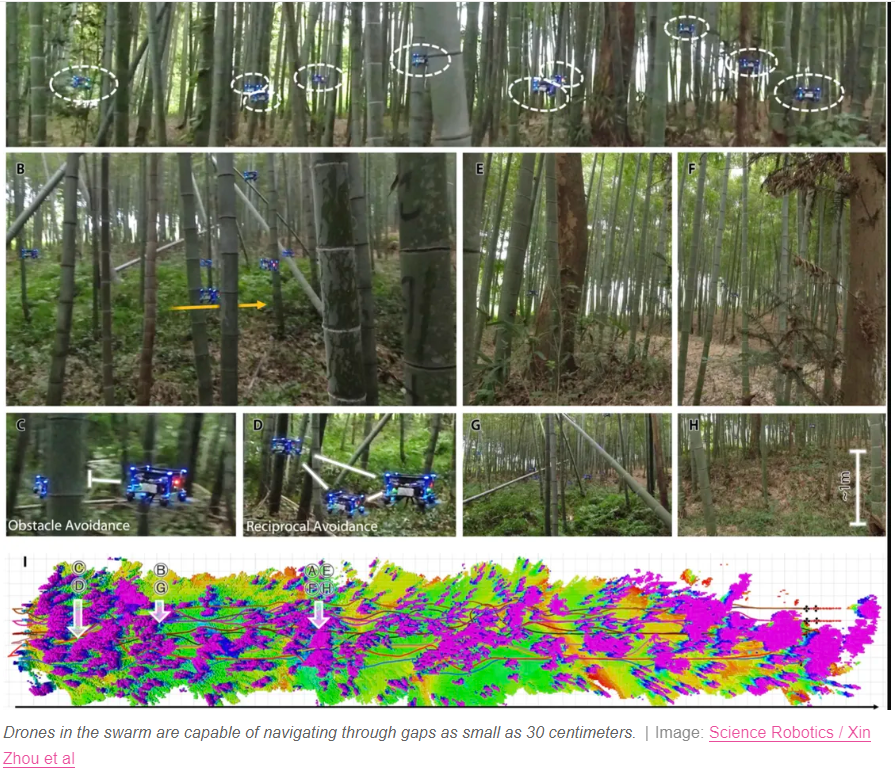
The scientists note that approaches to drone swarms tend to follow one of two programming paradigms: either “bird” or “insect.” In an “insect” swarm, the focus is on fast, reactive movements that require less forward-planning while a “bird” swarm tries to direct drones along long, flowing paths (the latter being the researchers’ approach). Both methods have their trade-offs, as thinking like an insect requires less computing power, but planning like a bird is more energy efficient. But, as the computing capacity of hardware improves, programming bird-like behavior has become more attainable.
Elke Schwarz, a senior lecturer at Queen Mary University of London whose specialisms include the use of drones in combat, notes that although the focus in such drone swarm research is often on these technological achievements, this can obscure the trickier questions of how such work should be deployed. She cites the observations of 20th century US mathematician Norbert Wiener, whose work laid the foundations for AI development.
Says Schwarz: “[Weiner] said — in the 1960s — that there is a disastrous focus on and obsession with ‘know-how’, which tends to eclipse the moral question we should be asking: what is it good for.”