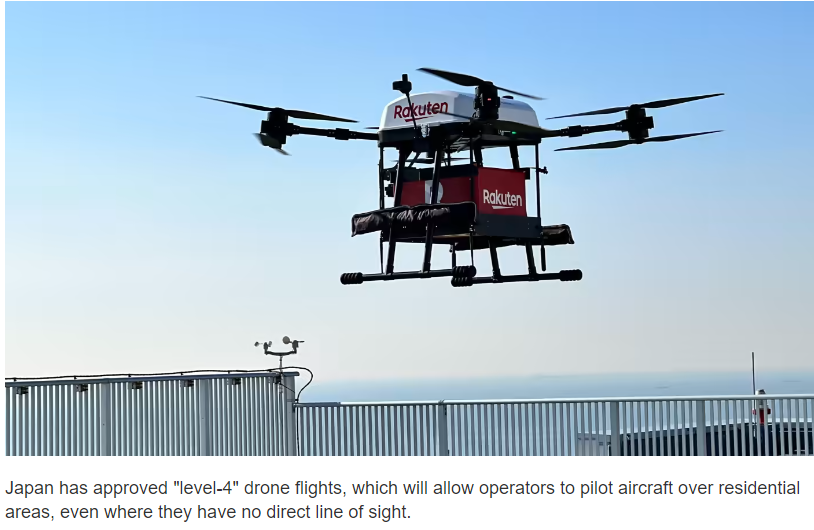
Japan’s revised civil aeronautics law came into force Monday, lifting a ban on drone flights beyond pilots’ visible range above urban districts.
Such drone flights will be permitted if the transport ministry gives approval in advance under a new system allowing qualified operators to fly drones that meet safety standards.
The removal of the ban is expected to give a tailwind to the commercialization of services using drones, such as for delivery in urban areas and shopping support in depopulated regions.
According to the ministry, actual urban-area drone flights beyond the visual line of sight are likely to begin next March or later as it takes time to certify drones and qualify pilots.
This time, the government removed the ban on Level 4 drone flights, the highest level of the country’s four-tier drone flight operation scale.
What issues must be dealt with for commercial drone flights to become common?
It will likely take time before drones can make the logistics business more efficient and help to ease the labor shortage in the transport industry. The three main issues are ensuring the safety and profitability of drone deliveries, and pilot training.
On the safety front, the transport ministry, said there were 139 accidents involving unmanned aircraft in Japan in fiscal 2021. In one case, a drone was buffeted by the wind, injuring a person’s hands, while in another case, a drone crashed, causing a fire in a riverbed.
If the number of level-4 flights increases, drones could collide in midair. The government is developing unmanned aircraft system traffic management (UTM) to help prevent accidents. The system will also take into account weather and geographic conditions.
There were about 320,000 registered drones in Japan as of the end of November. The government plans to install devices on all drones that transmit location information and incorporate these drones into the UTM.
Cost effectiveness is another issue. In many tests in the logistics industry, each drone had to be handled by at least two staff members. Some analysts say that if a single operator cannot manage multiple drones, commercial drone flights will not be profitable.
Finally, there is an urgent need to train more pilots and technicians. Certain skills are required to deal with problems, such as radio and system malfunctions, and even experienced drone pilots need more specialized skills to conduct level-4 flights.
What are other countries doing?
Across the Asia-Pacific region, governments have gradually been allowing drones for commercial and recreational use, and introducing relevant safety rules.
Australia has already put drones to practical commercial use. It has approved two drone delivery operators for specific locations and hours, according to the country’s civil aviation safety authority, enabling shipments of food, medical equipment and other items. For recreational use, pilots cannot fly drones at altitudes above 120 meters, and they must keep the drone at least 30 meters away from other people.
Malaysia also bans flying drones more than 400 feet (about 120 meters) off the ground without authorization from the civil aviation authority.
According to Yoshihiro Fujimaki, a specialist in next-generation aircraft and senior research fellow at the Japan International Transport and Tourism Institute, USA, some places overseas have already started or are on track to begin drone deliveries in urban areas. Amazon.com has been working on the concept of drone delivery since 2013 and obtained an air transport business license in 2020. The company plans to begin service in parts of Texas and elsewhere by the end of the year.
Additional reporting by Kentaro Iwamoto.