
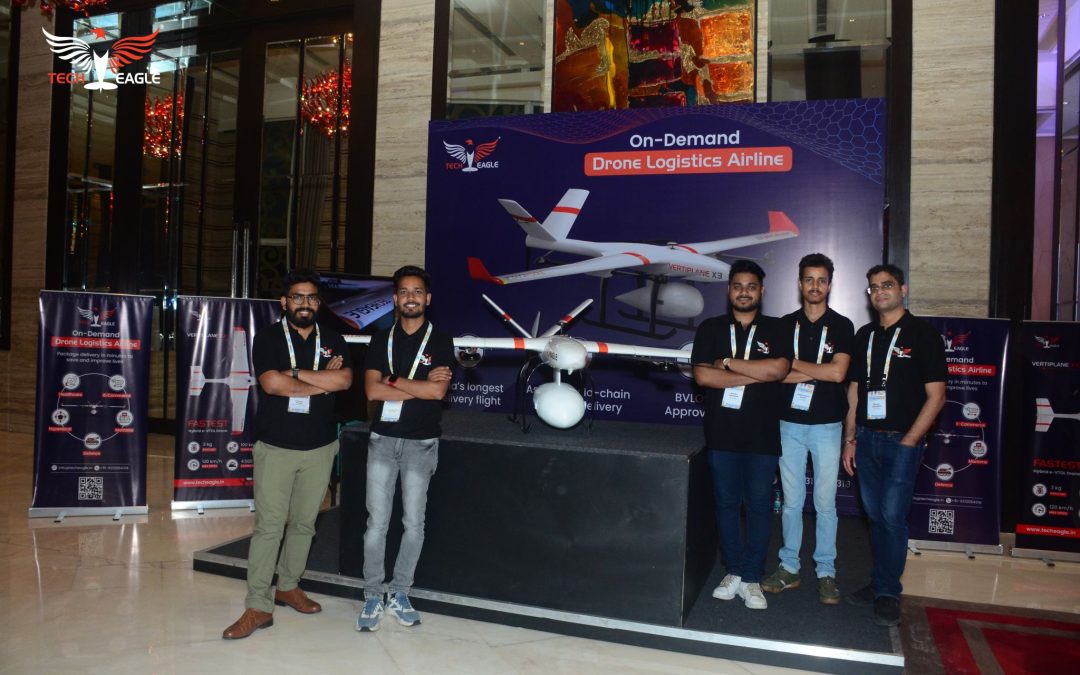
Photo credit: Tech Eagle
Due to data security worries about Chinese drones, Indian unmanned aerial vehicle (UAV) producers have found themselves in a nice spot.
Their made-in-India drones have begun to receive orders from around the world. ACSL, Japan’s largest sectoral player, has partnered with an Indian firm to produce in India for the rest of the world.
A growing number of countries are concerned that many Chinese drone manufacturers are keeping their servers in China. Last year, the United States, for example, slapped limitations on DJI, a Chinese drone manufacturer, as well as a few other Chinese firms.
Aerodyne, which has tied up with Japan’s ACSL, currently has a manufacturing unit in Tamil Nadu and will shortly open at least two more in other parts of India. “We are now setting up our own battery manufacturing unit in India to tackle the issue of battery shortage faced by the drone industry and ramp up manufacturing,” Arjun Aggarwal, MD of Aerodyne India group.
According to Tech Eagle creator Vikram Singh, Indian drones are equivalent to the best in the world in terms of quality while costing one-fifth to one-eighth of their worldwide counterparts. “We’ve agreed to work together to market drones to the Gulf and beyond.” “Right now, we’re making five drones each month,” Singh said. “In six months, we’ll be up to 15 drones per month, and in a year, we’ll be making one drone per day.”
According to Garuda Aerospace founder and CEO Agnishwar Jayaprakash, there is currently a “reluctance towards Chinese drones.” “There are data security worries regarding them, and the same goes for the servers, which are situated in China.” So far, we’ve had orders for 12,000 drones, mostly for agricultural, from Malaysia, South America, Panama, and Africa,” Jayaprakash said.
Agriculture drones account for three-quarters of the export orders, with the balance going to mapping and inspection. “India’s agriculture spray business is worth $3.2 billion, with 40 million acres under cultivation.” Drones spray insecticides more efficiently with fewer chemicals and water, and they are not dangerous to the person spraying because there is no physical touch,” Jayaprakash explained.





Recent Comments